
Joy Nieh is a Former Health Educator at the Charles B. Wang Community Health Center where she empowered the youth through health education as part of the Teen Resource Center team. She believes health education is essential to not only a healthy but purposeful and fulfilled life.
What Is A Well-Woman Exam (or Annual Gynecology Visit)?
Clinically reviewed by Pearl Tung, DNP

A well-woman exam (also called an annual gynecology or wellness visit) is a preventive care visit, like your annual primary care checkup. The difference is a well-woman exam is an annual checkup tailored for women's reproductive and sexual health.
Well-woman exams are very important—they help women detect and prevent cancers, diseases and other illnesses.1 It is also a safe space to ask a provider about any questions about sexual or reproductive health and discuss topics like birth control options, pregnancy, or concerns about your menses or period.
What to Expect
A well-woman exam will begin with a discussion. The provider will ask you questions about your medical history including your family history, your period, and your lifestyle.2 Questions can include:
- When was your last period?
- How often do you have periods?
- Are you sexually active?
- Do you use birth control?
- Are you planning for pregnancy this year?
- Do you smoke or drink alcohol? How often?
If you have any questions or concerns about your health, you can bring them up to your provider as well.
Next, your provider will take your vital signs, including your height, weight, and blood pressure to screen for any potential conditions such as high blood pressure or diabetes.
Screenings Included in a Well-Woman Exam
Depending on your age, medical and family history, and how recently you have been tested, there are a few screenings that may be done during your visit.3
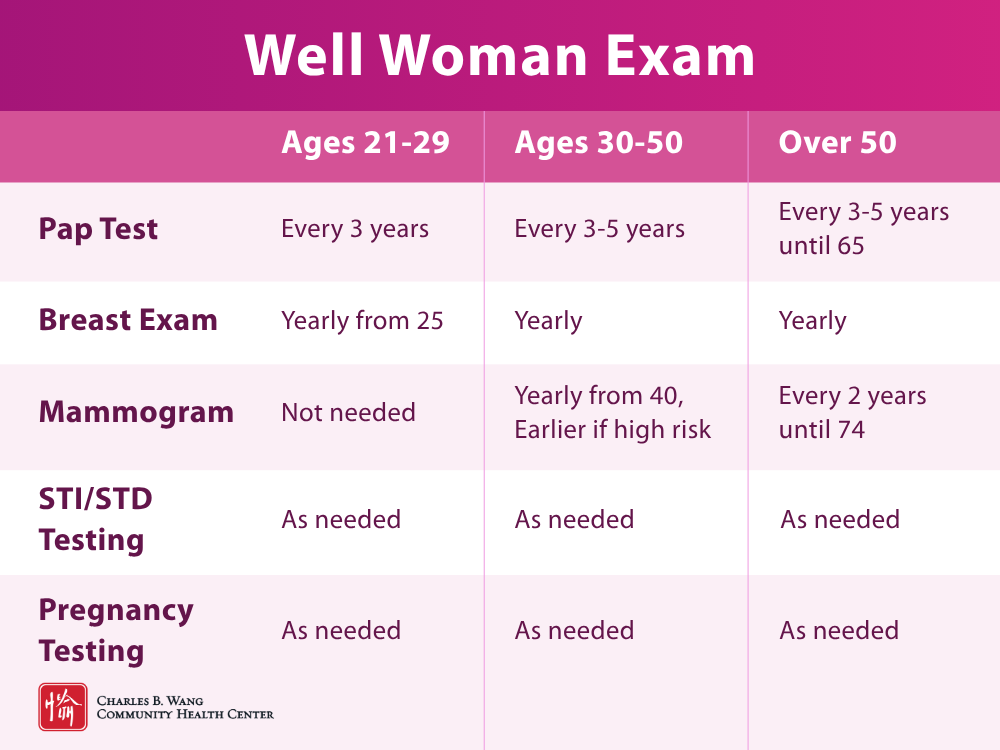
Personalized Counseling & Preventive Care
After the screenings, the provider will discuss the results of the exam and any follow-up steps or treatment options.
Seeing your Family Medicine or obstetrics and gynecology (OB/GYN) provider regularly for well-woman exams is an opportunity to build a trusting, longstanding relationship with your provider. It may feel awkward or strange to speak to a provider about intimate topics, but remember that your provider is there to help and your reproductive and sexual health is important to your overall health. Having a strong, trusting relationship can be particularly helpful when you have questions about topics such as:
- Birth control options
- Pregnancy planning
- Abortion and miscarriage
- STI/STDs
- Sex and sexuality
- Cancer symptoms (including cervical and breast cancer)
- Period concerns or questions
- Menopause
Your provider can also give personalized guidance on your overall health. This includes any concerns or questions you may have regarding your physical or mental health.
Who Should Get a Well-Woman Exam?
All persons assigned female at birth over 18 years old should have a yearly well-woman exam. The American College of Obstetricians and Gynecologists (ACOG) recommends the first visit be done between 13 and 15 years old.4 After the initial visit, it is recommended to have a well-woman exam every year.
Book Your Well-Woman Exam at the Charles B. Wang Community Health Center
Charles B. Wang Community Health Center's obstetrics and gynecology (OB/GYN) department provides well-woman exams to women of all ages, during all stages of life.
Our approach is centered around patient needs; we offer high-quality, comprehensive care to our patients. We want to make sure you have access to the services you seek. We have multilingual obstetrician and gynecologists who speak languages such as Mandarin & Cantonese Chinese, Spanish, Korean and Bengali. Whether you are seeking guidance on contraceptives, pregnancy, or specialized care, our medical professionals are here to listen to and offer expert advice tailored to you. We know that sexual and reproductive health isn't just about physical wellness—it's about your emotional well-being, lifestyle choices, and cultural background. This is why we work around the different needs of women throughout their journey.
Schedule your well-woman exam at one of our convenient and accessible locations in Flushing, Queens and Lower Manhattan. Book an appointment and visit our office today!
FAQ
1.What is a pap smear and do I need one done every year?
A pap smear, also called a pap test is cervical cancer screening test. During a pap test, the doctor uses a small wand to collect cells from the cervix to check for abnormalities. The doctor will use an instrument called a speculum to open the vagina; this will allow the provider to better see the cervix and accurately collect the sample. Sometimes a pap test can be uncomfortable, but it should not be painful, and you can return to your daily activities directly after. You will need a pap smear every 3-5 years depending on your age.3
2.What is a pelvic exam?
Pelvic exam is a preventive service you may receive during your well-woman visit. During the pelvic exam your provider checks your reproductive organs—the vulva, vagina, cervix, ovaries, uterus, rectum, and pelvis for any unusual signs or changes.5
When a provider conducts a pelvic exam they may also conduct a pap test, but a pelvic exam is not necessary to receive most sexual health care, including receiving a pap test.
3.How is a breast exam done?
During a clinical breast exam (CBE), a doctor will carefully feel your breasts, underarms, and the area below your collar bone for any abnormalities or unusual changes. 6 The provider will also check your breasts while you are sitting up and when you are lying down.
4.Can I have a well-woman exam if I am on my period?
Yes, many of the components of a well woman exam can be completed while you are on your period.
While you may consider planning your well-woman exam on a date you do not expect to have your period, this may not always be possible (especially if you are having period concerns). Some tests like the pap test could be less accurate during menstruation, depending on your flow, but pap tests are not conducted at every visit.7 You can always message or call your care team if you have any questions or concerns about how your period may impact your care. Whether you have your visit on your period or reschedule is entirely up to you. Make the choice that feels the most comfortable for you. Either way, your period should not prevent you from receiving regular care for your reproductive and sexual health.
Sources
- https://4collegewomen.org/fact-sheets/firstgyno.html
- https://mychn.org/what-to-expect-during-your-well-woman-exam/
- https://www.goodrx.com/health-topic/womens-health/well-woman-exam
- https://www.acog.org/clinical/clinical-guidance/committee-opinion/articles/2020/10/the-initial-reproductive-health-visit
- https://www.mayoclinic.org/tests-procedures/pelvic-exam/about/pac-20385135
- https://www.komen.org/breast-cancer/screening/clinical-breast-exam/
- https://womenshealth.gov/a-z-topics/pap-hpv-tests
Related Articles





A Practical Guide to Managing Seasonal Allergies
By Joy Nieh, MA
Clinically reviewed by Kim Bui, MD